
Russian Arctic


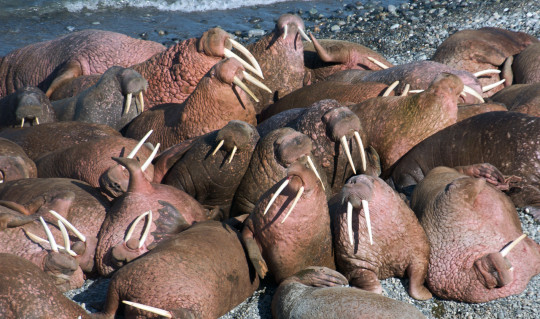


There are many jewels to experience in the Russian Far East – it is a place of mystery and wilderness, snow-capped volcanoes and uninhabited islands, alpine meadows and lowland forests.
The Kamchatka Peninsula and Kuril islands are some of the most geologically active and biologically rich parts of the planet and support a wide diversity of birdlife. It is only really in this century that the region has been open to visitors at all, and because of the lack of infrastructure, the best way to explore is by ship and boat.
Chukotka is in the very north eastern part of Eurasia and has one of the harshest environments on anywhere in the world. Despite this there is plenty of wildlife to see, including the extremely rare spoon-billed sandpiper. You will also have the opportunity to meet the local Chukchis who make their life in this untamed wilderness.
Some of our voyages also take in the remote Commander Islands where the famous Danish explorer Vitus Bering and 28 men of his company died in 1741, and Wrangel Island whose nature reserve is often referred to as the maternity ward for polar bears!

Itineraries relating to the Russian Arctic

Map

Comments

Receive our E-News
Fill in your details to subscribe to our regular Dispatches E-newsletter

SIGN UP FOR E-NEWS
Our Brochure
View a PDF or order a copy of our Brochure
VIEW OR ORDER BROCHURE HERE

Far Frontiers Travel
Our sister company, Far Frontiers Travel, specialises in tailor-making bespoke travel to Central Asia, China and Mongolia, the Far East, Indian Subcontinent and the Himalayas, Indochina, Myanmar, Middle East, North Africa and Europe, Russia and South America.
VISIT SITE
Clients’ comments
“Once again thank you very much for yet another wonderful trip to the Arctic. Memories from this trip have surpassed some of those of previous visits to this part of the world. The whole voyage provided me (and fellow passengers) the chance to see a part of the Arctic seen by few people and experience the vastness of the Northern Sea Route and the challenges it presents in the future”.
Peter Wright, The Northern Sea Route and Wrangel Island
“A brilliant holiday! Franz Josef Land must be the ultimate Arctic experience.”
Barbara Forrai and Margaret Dykes, Franz Josef Land
“This was a wonderful trip. Getting there and back was slightly trying, not because of the airlines (both Transaero and Yakutia were good) but because of the length of the flights, the hassle of boarding, stopping over in Irkutsk on the way back, and of course the time changes (3 hours London/Moscow, nearly 9 hours Moscow/Petropavlovsk, and the reverse on the way back. The voyage itself was splendid. There were some early starts and late finishes, a few rather optimistic ‘dry landings’ from zodiacs (I always wore rubber wellingtons and always needed them) and one optimistic ‘walk’ through a pass between bays which involved ploughing through deep/very deep snow for about a mile while on a slope most of the way. But we took these in our stride. We saw tons of wildlife – literally; at least two dozen whales, more than 5,000 hauled-out walruses, about 50 sea-lions, dozens of seals, and at least 15 brown bears. We were successful in finding the spoon-billed sandpiper, and the scientific element of the trip was both enlightening and exciting.”
Chris Meader, In Bering’s wake, in search of the spoon-billed sandpiper
“As Marion promised, I attach a copy of the log from our recent trip to Franz Josef Land. The photos in the log illustrate the quality of the polar bear encounters! Dense sea ice is definitely the place to see bears at close range, and we couldn’t have got into the middle of it without an icebreaker. In one twenty-four hour period we had fourteen bear encounters. Often with two in view at the same time. (That 14 count involved some repeat visits by the same bear, who seemed fascinated by the ship).”
Grant Hutchison and Marion McMurdo, Franz Josef Land